what degree of rotation about the origin will cause the triangle below to ma ponto itself
| Circle | |
|---|---|
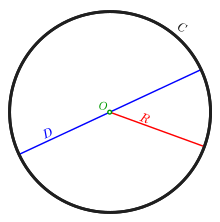 A circle (black), which is measured by its circumference (C), diameter (D) in blue, and radius (R) in red; its centre (O) is in greenish. | |
| Type | Conic section |
| Symmetry grouping | O(2) |
| Area | πR2 |
| Perimeter | C = 2πR |
A circumvolve is a shape consisting of all points in a plane that are at a given distance from a given point, the center; equivalently it is the curve traced out by a bespeak that moves in a plane then that its distance from a given bespeak is constant. The altitude between any point of the circle and the eye is chosen the radius. Usually, the radius is required to be a positive number. A circumvolve with is a degenerate example. This commodity is about circles in Euclidean geometry, and, in detail, the Euclidean plane, except where otherwise noted.

Specifically, a circle is a uncomplicated airtight curve that divides the plane into ii regions: an interior and an exterior. In everyday utilize, the term "circumvolve" may be used interchangeably to refer to either the boundary of the figure, or to the whole effigy including its interior; in strict technical usage, the circle is only the purlieus and the whole figure is called a disc.
A circle may also be defined every bit a special kind of ellipse in which the two foci are coincident, the eccentricity is 0, and the semi-major and semi-minor axes are equal; or the 2-dimensional shape enclosing the most surface area per unit perimeter squared, using calculus of variations.
Euclid's definition
A circumvolve is a airplane figure divisional by one curved line, and such that all direct lines drawn from a certain point within it to the bounding line, are equal. The bounding line is called its circumference and the point, its centre.
Topological definition
In the field of topology, a circle isn't limited to the geometric concept, but to all of its homeomorphisms. Two topological circles are equivalent if i tin be transformed into the other via a deformation of R three upon itself (known as an ambient isotopy).[2]
Terminology
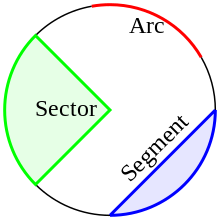
- Annulus: a ring-shaped object, the region bounded past two concentric circles.
- Arc: any continued function of a circumvolve. Specifying two stop points of an arc and a middle allows for two arcs that together make up a full circumvolve.
- Centre: the point equidistant from all points on the circle.
- Chord: a line segment whose endpoints lie on the circle, thus dividing a circumvolve into two segments.
- Circumference: the length of i circuit along the circle, or the distance around the circle.
- Bore: a line segment whose endpoints lie on the circle and that passes through the center; or the length of such a line segment. This is the largest distance between any two points on the circle. It is a special instance of a chord, namely the longest chord for a given circumvolve, and its length is twice the length of a radius.
- Disc: the region of the plane bounded by a circle.
- Lens: the region common to (the intersection of) 2 overlapping discs.
- Passant: a coplanar direct line that has no point in mutual with the circle.
- Radius: a line segment joining the eye of a circle with any single point on the circle itself; or the length of such a segment, which is half (the length of) a diameter.
- Sector: a region bounded past 2 radii of equal length with a mutual eye and either of the two possible arcs, determined by this middle and the endpoints of the radii.
- Segment: a region bounded by a chord and one of the arcs connecting the chord'south endpoints. The length of the chord imposes a lower boundary on the bore of possible arcs. Sometimes the term segment is used simply for regions non containing the center of the circle to which their arc belongs to.
- Secant: an extended chord, a coplanar straight line, intersecting a circumvolve in ii points.
- Semicircle: ane of the 2 possible arcs determined by the endpoints of a diameter, taking its midpoint as center. In not-technical mutual usage information technology may mean the interior of the two dimensional region divisional by a diameter and i of its arcs, that is technically called a half-disc. A half-disc is a special example of a segment, namely the largest one.
- Tangent: a coplanar straight line that has 1 single point in common with a circumvolve ("touches the circumvolve at this indicate").
All of the specified regions may be considered equally open up, that is, not containing their boundaries, or as closed, including their corresponding boundaries.
| Chord, secant, tangent, radius, and bore | |

History

The compass in this 13th-century manuscript is a symbol of God'due south human action of Creation. Notice as well the circular shape of the halo.
The word circumvolve derives from the Greek κίρκος/κύκλος (kirkos/kuklos), itself a metathesis of the Homeric Greek κρίκος (krikos), pregnant "hoop" or "ring".[three] The origins of the words circus and excursion are closely related.

Circular piece of silk with Mongol images

The circumvolve has been known since before the beginning of recorded history. Natural circles would take been observed, such every bit the Moon, Sun, and a curt plant stalk bravado in the air current on sand, which forms a circle shape in the sand. The circle is the ground for the wheel, which, with related inventions such as gears, makes much of modern mechanism possible. In mathematics, the study of the circle has helped inspire the development of geometry, astronomy and calculus.
Early on scientific discipline, particularly geometry and astrology and astronomy, was connected to the divine for most medieval scholars, and many believed that at that place was something intrinsically "divine" or "perfect" that could be found in circles.[4] [v]
Some highlights in the history of the circle are:
- 1700 BCE – The Rhind papyrus gives a method to find the area of a circular field. The result corresponds to 256 / 81 (3.16049...) as an approximate value of π.[6]

- 300 BCE – Volume three of Euclid'south Elements deals with the properties of circles.
- In Plato's Seventh Letter there is a detailed definition and explanation of the circle. Plato explains the perfect circle, and how information technology is dissimilar from any drawing, words, definition or explanation.
- 1880 CE – Lindemann proves that π is transcendental, effectively settling the millennia-old problem of squaring the circle.[7]
Analytic results
Circumference
The ratio of a circle's circumference to its diameter is π (pi), an irrational abiding approximately equal to iii.141592654. Thus the circumference C is related to the radius r and bore d by:

Surface area enclosed
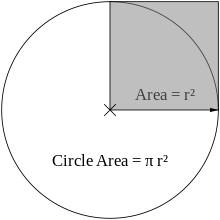
Area enclosed by a circle = π × surface area of the shaded square
Equally proved past Archimedes, in his Measurement of a Circle, the expanse enclosed by a circle is equal to that of a triangle whose base has the length of the circle'due south circumference and whose height equals the circle'southward radius,[eight] which comes to π multiplied past the radius squared:

Equivalently, denoting diameter past d,
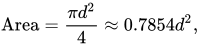
that is, approximately 79% of the circumscribing square (whose side is of length d).
The circumvolve is the plane curve enclosing the maximum area for a given arc length. This relates the circumvolve to a problem in the calculus of variations, namely the isoperimetric inequality.
Equations
Cartesian coordinates

Circle of radius r = 1, centre (a,b) = (1.2, −0.5)
- Equation of a circle
In an x–y Cartesian coordinate arrangement, the circumvolve with heart coordinates (a, b) and radius r is the prepare of all points (10, y) such that

This equation, known equally the equation of the circumvolve, follows from the Pythagorean theorem applied to whatsoever point on the circumvolve: as shown in the adjacent diagram, the radius is the hypotenuse of a correct-angled triangle whose other sides are of length |x − a| and |y − b|. If the circle is centred at the origin (0, 0), and then the equation simplifies to

- Parametric grade
The equation can be written in parametric form using the trigonometric functions sine and cosine every bit


where t is a parametric variable in the range 0 to iiπ, interpreted geometrically equally the angle that the ray from (a,b) to (x,y) makes with the positive ten axis.
An alternative parametrisation of the circle is
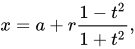
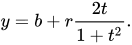
In this parameterisation, the ratio of t to r tin exist interpreted geometrically equally the stereographic projection of the line passing through the heart parallel to the x axis (run into Tangent half-angle substitution). However, this parameterisation works but if t is made to range not only through all reals merely also to a point at infinity; otherwise, the leftmost point of the circle would exist omitted.
- 3-point form
The equation of the circle adamant by 3 points not on a line is obtained by a conversion of the iii-point class of a circle equation:


- Homogeneous form
In homogeneous coordinates, each conic section with the equation of a circle has the form

It can exist proven that a conic section is a circumvolve exactly when information technology contains (when extended to the circuitous projective airplane) the points I(1: i: 0) and J(1: −i: 0). These points are called the circular points at infinity.
Polar coordinates
In polar coordinates, the equation of a circle is

where a is the radius of the circumvolve, are the polar coordinates of a generic bespeak on the circumvolve, and are the polar coordinates of the centre of the circle (i.e., r 0 is the distance from the origin to the centre of the circle, and φ is the anticlockwise angle from the positive x centrality to the line connecting the origin to the centre of the circumvolve). For a circle centred on the origin, i.e. r 0 = 0, this reduces to but r = a . When r 0 = a , or when the origin lies on the circle, the equation becomes



In the full general case, the equation can exist solved for r, giving

Notation that without the ± sign, the equation would in some cases describe simply half a circle.
Complex plane
In the complex plane, a circle with a centre at c and radius r has the equation

In parametric form, this can exist written as

The slightly generalised equation

for real p, q and complex g is sometimes called a generalised circumvolve. This becomes the higher up equation for a circle with , since . Not all generalised circles are actually circles: a generalised circle is either a (true) circle or a line.


Tangent lines
The tangent line through a point P on the circle is perpendicular to the diameter passing through P. If P = (ten 1, y 1) and the circle has heart (a, b) and radius r, and so the tangent line is perpendicular to the line from (a, b) to (x 1, y i), so information technology has the form (10 one − a)x + (y one – b)y = c . Evaluating at (x i, y 1) determines the value of c, and the result is that the equation of the tangent is

or

If y i ≠ b , and so the slope of this line is
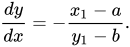
This tin likewise exist found using implicit differentiation.
When the centre of the circle is at the origin, so the equation of the tangent line becomes

and its slope is

Backdrop
- The circle is the shape with the largest surface area for a given length of perimeter (see Isoperimetric inequality).
- The circle is a highly symmetric shape: every line through the centre forms a line of reflection symmetry, and it has rotational symmetry around the heart for every bending. Its symmetry group is the orthogonal group O(2,R). The group of rotations alone is the circle group T.
- All circles are similar.
- A circumvolve circumference and radius are proportional.
- The expanse enclosed and the square of its radius are proportional.
- The constants of proportionality are 2π and π respectively.
- The circle that is centred at the origin with radius 1 is chosen the unit of measurement circumvolve.
- Thought of as a bully circle of the unit of measurement sphere, it becomes the Riemannian circle.
- Through any iii points, non all on the same line, at that place lies a unique circle. In Cartesian coordinates, information technology is possible to requite explicit formulae for the coordinates of the centre of the circumvolve and the radius in terms of the coordinates of the three given points. See circumcircle.
Chord
- Chords are equidistant from the centre of a circle if and only if they are equal in length.
- The perpendicular bisector of a chord passes through the centre of a circle; equivalent statements stemming from the uniqueness of the perpendicular bisector are:
- A perpendicular line from the centre of a circle bisects the chord.
- The line segment through the centre bisecting a chord is perpendicular to the chord.
- If a central angle and an inscribed angle of a circle are subtended by the aforementioned chord and on the same side of the chord, and then the central bending is twice the inscribed angle.
- If two angles are inscribed on the aforementioned chord and on the same side of the chord, then they are equal.
- If two angles are inscribed on the same chord and on reverse sides of the chord, then they are supplementary.
- For a cyclic quadrilateral, the exterior angle is equal to the interior reverse angle.
- An inscribed bending subtended by a diameter is a correct angle (run across Thales' theorem).
- The bore is the longest chord of the circumvolve.
- Among all the circles with a chord AB in common, the circumvolve with minimal radius is the one with diameter AB.
- If the intersection of any ii chords divides one chord into lengths a and b and divides the other chord into lengths c and d, then ab = cd .
- If the intersection of any two perpendicular chords divides one chord into lengths a and b and divides the other chord into lengths c and d, so a 2 + b 2 + c ii + d 2 equals the square of the diameter.[9]
- The sum of the squared lengths of any ii chords intersecting at right angles at a given point is the same as that of any other two perpendicular chords intersecting at the same indicate and is given by 8r 2 − 4p 2, where r is the circle radius, and p is the altitude from the centre indicate to the point of intersection.[10]
- The distance from a point on the circle to a given chord times the diameter of the circle equals the production of the distances from the point to the ends of the chord.[eleven] : p.71
Tangent
- A line fatigued perpendicular to a radius through the end point of the radius lying on the circle is a tangent to the circle.
- A line fatigued perpendicular to a tangent through the point of contact with a circle passes through the eye of the circumvolve.
- 2 tangents tin always exist fatigued to a circle from any bespeak outside the circle, and these tangents are equal in length.
- If a tangent at A and a tangent at B intersect at the outside point P, then denoting the eye every bit O, the angles ∠BOA and ∠BPA are supplementary.
- If AD is tangent to the circle at A and if AQ is a chord of the circle, then ∠DAQ = one / 2 arc(AQ).
Theorems
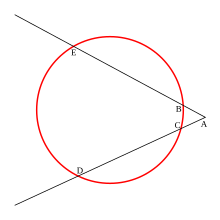
- The chord theorem states that if two chords, CD and EB, intersect at A, then Air-conditioning × AD = AB × AE .
- If two secants, AE and AD, likewise cutting the circle at B and C respectively, then Ac × Ad = AB × AE (corollary of the chord theorem).
- A tangent can be considered a limiting case of a secant whose ends are coincident. If a tangent from an external point A meets the circle at F and a secant from the external point A meets the circle at C and D respectively, then AF 2 = Ac × Advertizement (tangent–secant theorem).
- The angle between a chord and the tangent at one of its endpoints is equal to one half the angle subtended at the centre of the circumvolve, on the opposite side of the chord (tangent chord angle).
- If the bending subtended past the chord at the centre is xc°, then ℓ = r √ii , where ℓ is the length of the chord, and r is the radius of the circle.
- If 2 secants are inscribed in the circumvolve as shown at right, then the measurement of angle A is equal to 1 half the deviation of the measurements of the enclosed arcs ( and ). That is, , where O is the centre of the circle (secant–secant theorem).



Inscribed angles
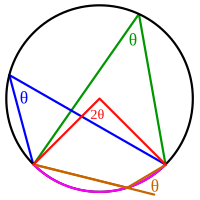
An inscribed angle (examples are the bluish and green angles in the effigy) is exactly half the respective central angle (ruby). Hence, all inscribed angles that subtend the aforementioned arc (pink) are equal. Angles inscribed on the arc (brown) are supplementary. In particular, every inscribed angle that subtends a bore is a correct angle (since the cardinal angle is 180°).
Sagitta
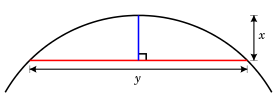
The sagitta is the vertical segment.
The sagitta (likewise known as the versine) is a line segment drawn perpendicular to a chord, between the midpoint of that chord and the arc of the circumvolve.
Given the length y of a chord and the length x of the sagitta, the Pythagorean theorem can be used to calculate the radius of the unique circle that will fit around the 2 lines:
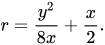
Another proof of this event, which relies just on two chord properties given above, is as follows. Given a chord of length y and with sagitta of length x, since the sagitta intersects the midpoint of the chord, we know that it is a role of a diameter of the circle. Since the diameter is twice the radius, the "missing" part of the bore is (twor − ten ) in length. Using the fact that i function of one chord times the other office is equal to the same production taken along a chord intersecting the first chord, we find that (iir − x)10 = (y / 2)2 . Solving for r, we find the required result.
Compass and straightedge constructions
There are many compass-and-straightedge constructions resulting in circles.
The simplest and virtually basic is the structure given the centre of the circumvolve and a signal on the circle. Identify the stock-still leg of the compass on the centre point, the movable leg on the betoken on the circumvolve and rotate the compass.
Structure with given diameter
- Construct the midpoint M of the diameter.
- Construct the circle with middle Thousand passing through i of the endpoints of the diameter (it will too pass through the other endpoint).

Construct a circle through points A, B and C past finding the perpendicular bisectors (red) of the sides of the triangle (blueish). Only two of the three bisectors are needed to detect the centre.
Structure through 3 noncollinear points
- Name the points P , Q and R ,
- Construct the perpendicular bisector of the segment PQ .
- Construct the perpendicular bisector of the segment PR .
- Label the betoken of intersection of these two perpendicular bisectors K . (They meet because the points are not collinear).
- Construct the circle with centre M passing through one of the points P , Q or R (it will likewise pass through the other two points).
Circle of Apollonius

Apollonius' definition of a circle: d 1/d ii abiding
Apollonius of Perga showed that a circumvolve may also exist divers every bit the ready of points in a aeroplane having a abiding ratio (other than 1) of distances to two fixed foci, A and B.[12] [13] (The set of points where the distances are equal is the perpendicular bisector of segment AB, a line.) That circle is sometimes said to exist drawn most ii points.
The proof is in two parts. First, one must evidence that, given two foci A and B and a ratio of distances, any bespeak P satisfying the ratio of distances must fall on a particular circle. Permit C exist another point, also satisfying the ratio and lying on segment AB. By the angle bisector theorem the line segment PC will bifurcate the interior angle APB, since the segments are similar:
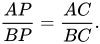
Analogously, a line segment PD through some indicate D on AB extended bisects the respective outside bending BPQ where Q is on AP extended. Since the interior and exterior angles sum to 180 degrees, the angle CPD is exactly xc degrees; that is, a right angle. The prepare of points P such that angle CPD is a right angle forms a circle, of which CD is a bore.
2nd, see[fourteen] : p.fifteen for a proof that every betoken on the indicated circumvolve satisfies the given ratio.
Cantankerous-ratios
A closely related property of circles involves the geometry of the cross-ratio of points in the complex plane. If A, B, and C are as to a higher place, then the circumvolve of Apollonius for these three points is the collection of points P for which the absolute value of the cross-ratio is equal to 1:
![{\displaystyle {\big |}[A,B;C,P]{\big |}=1.}](https://wikimedia.org/api/rest_v1/media/math/render/svg/c011d38473f7a9ade63598db287ee36d5827d93a)
Stated another way, P is a point on the circumvolve of Apollonius if and just if the cantankerous-ratio [A, B; C, P] is on the unit circle in the complex plane.
Generalised circles
If C is the midpoint of the segment AB, and then the collection of points P satisfying the Apollonius condition
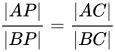
is not a circle, simply rather a line.
Thus, if A, B, and C are given distinct points in the airplane, then the locus of points P satisfying the to a higher place equation is called a "generalised circle." It may either exist a true circle or a line. In this sense a line is a generalised circle of infinite radius.
Inscription in or circumscription about other figures
In every triangle a unique circumvolve, called the incircle, tin can exist inscribed such that it is tangent to each of the three sides of the triangle.[fifteen]
About every triangle a unique circle, chosen the circumcircle, tin be circumscribed such that information technology goes through each of the triangle's 3 vertices.[16]
A tangential polygon, such equally a tangential quadrilateral, is whatsoever convex polygon within which a circle tin be inscribed that is tangent to each side of the polygon.[17] Every regular polygon and every triangle is a tangential polygon.
A cyclic polygon is any convex polygon about which a circle can be circumscribed, passing through each vertex. A well-studied example is the circadian quadrilateral. Every regular polygon and every triangle is a cyclic polygon. A polygon that is both cyclic and tangential is called a bicentric polygon.
A hypocycloid is a curve that is inscribed in a given circle by tracing a fixed bespeak on a smaller circle that rolls within and tangent to the given circle.
Limiting case of other figures
The circle can be viewed as a limiting case of each of various other figures:
- A Cartesian oval is a gear up of points such that a weighted sum of the distances from any of its points to two fixed points (foci) is a abiding. An ellipse is the case in which the weights are equal. A circle is an ellipse with an eccentricity of zero, pregnant that the two foci coincide with each other as the centre of the circle. A circle is besides a different special case of a Cartesian oval in which one of the weights is zip.
- A superellipse has an equation of the form for positive a, b, and north. A supercircle has b = a . A circle is the special case of a supercircle in which due north = two.
- A Cassini oval is a prepare of points such that the production of the distances from any of its points to ii fixed points is a constant. When the two fixed points coincide, a circle results.
- A curve of constant width is a figure whose width, defined as the perpendicular distance between two distinct parallel lines each intersecting its boundary in a single point, is the same regardless of the direction of those two parallel lines. The circle is the simplest instance of this type of effigy.
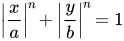
In other p-norms

Illustrations of unit circles (see likewise superellipse) in dissimilar p -norms (every vector from the origin to the unit circle has a length of one, the length existence calculated with length-formula of the corresponding p ).
Defining a circle as the set of points with a stock-still altitude from a betoken, different shapes can be considered circles under dissimilar definitions of distance. In p-norm, altitude is determined by

In Euclidean geometry, p = two, giving the familiar

In taxicab geometry, p = 1. Taxicab circles are squares with sides oriented at a 45° angle to the coordinate axes. While each side would have length using a Euclidean metric, where r is the circle's radius, its length in taxicab geometry is 2r. Thus, a circumvolve'southward circumference is eightr. Thus, the value of a geometric analog to is 4 in this geometry. The formula for the unit circle in taxicab geometry is in Cartesian coordinates and


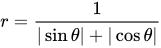
in polar coordinates.
A circle of radius 1 (using this altitude) is the von Neumann neighborhood of its center.
A circle of radius r for the Chebyshev altitude (50∞ metric) on a plane is besides a foursquare with side length 2r parallel to the coordinate axes, so planar Chebyshev altitude can be viewed as equivalent by rotation and scaling to planar taxicab distance. Withal, this equivalence between Fiftyone and L∞ metrics does not generalize to higher dimensions.
Locus of abiding sum
Consider a finite prepare of points in the aeroplane. The locus of points such that the sum of the squares of the distances to the given points is constant is a circle, whose eye is at the centroid of the given points.[18] A generalization for higher powers of distances is obtained if under points the vertices of the regular polygon are taken.[19] The locus of points such that the sum of the -th ability of distances to the vertices of a given regular polygon with circumradius is constant is a circle, if


- , where =ane,2,…, -1;
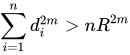

whose center is the centroid of the .
In the case of the equilateral triangle, the loci of the abiding sums of the 2d and fourth powers are circles, whereas for the square, the loci are circles for the constant sums of the 2nd, quaternary, and 6th powers. For the regular pentagon the constant sum of the eighth powers of the distances will exist added and and so forth.
Squaring the circle
Squaring the circle is the problem, proposed by ancient geometers, of constructing a foursquare with the aforementioned area every bit a given circle by using only a finite number of steps with compass and straightedge.
In 1882, the job was proven to be impossible, as a consequence of the Lindemann–Weierstrass theorem, which proves that pi (π) is a transcendental number, rather than an algebraic irrational number; that is, it is not the root of any polynomial with rational coefficients. Despite the impossibility, this topic continues to be of interest for pseudomath enthusiasts.
Significance in art and symbolism
From the fourth dimension of the earliest known civilisations – such as the Assyrians and ancient Egyptians, those in the Indus Valley and forth the Yellow River in People's republic of china, and the Western civilisations of ancient Greece and Rome during classical Antiquity – the circle has been used straight or indirectly in visual art to convey the artist'south message and to express certain ideas. However, differences in worldview (behavior and culture) had a great affect on artists' perceptions. While some emphasised the circumvolve's perimeter to demonstrate their democratic manifestation, others focused on its center to symbolise the concept of cosmic unity. In mystical doctrines, the circle mainly symbolises the infinite and cyclical nature of existence, but in religious traditions it represents heavenly bodies and divine spirits. The circle signifies many sacred and spiritual concepts, including unity, infinity, wholeness, the universe, divinity, balance, stability and perfection, amidst others. Such concepts accept been conveyed in cultures worldwide through the use of symbols, for case, a compass, a halo, the vesica piscis and its derivatives (fish, eye, aureole, mandorla, etc.), the ouroboros, the Dharma wheel, a rainbow, mandalas, rose windows and so along.[20]
Run into likewise
References
- ^ OL 7227282M
- ^ Gamelin, Theodore (1999). Introduction to topology . Mineola, N.Y: Dover Publications. ISBN0486406806.
- ^ krikos Archived 2013-11-06 at the Wayback Motorcar, Henry George Liddell, Robert Scott, A Greek-English Lexicon, on Perseus
- ^ Arthur Koestler, The Sleepwalkers: A History of Man's Changing Vision of the Universe (1959)
- ^ Proclus, The Half-dozen Books of Proclus, the Platonic Successor, on the Theology of Plato Archived 2017-01-23 at the Wayback Machine Tr. Thomas Taylor (1816) Vol. 2, Ch. 2, "Of Plato"
- ^ Chronology for 30000 BC to 500 BC Archived 2008-03-22 at the Wayback Motorcar. History.mcs.st-andrews.ac.united kingdom. Retrieved on 2012-05-03.
- ^ Squaring the circle Archived 2008-06-24 at the Wayback Motorcar. History.mcs.st-andrews.ac.britain. Retrieved on 2012-05-03.
- ^ Katz, Victor J. (1998), A History of Mathematics / An Introduction (2nd ed.), Addison Wesley Longman, p. 108, ISBN978-0-321-01618-8
- ^ Posamentier and Salkind, Challenging Problems in Geometry, Dover, 2nd edition, 1996: pp. 104–105, #iv–23.
- ^ Higher Mathematics Journal 29(4), September 1998, p. 331, trouble 635.
- ^ Johnson, Roger A., Advanced Euclidean Geometry, Dover Publ., 2007.
- ^ Harkness, James (1898). "Introduction to the theory of analytic functions". Nature. 59 (1530): 30. Bibcode:1899Natur..59..386B. doi:10.1038/059386a0. S2CID 4030420. Archived from the original on 2008-10-07.
- ^ Ogilvy, C. Stanley, Excursions in Geometry, Dover, 1969, fourteen–17.
- ^ Altshiller-Court, Nathan, College Geometry, Dover, 2007 (orig. 1952).
- ^ Incircle – from Wolfram MathWorld Archived 2012-01-21 at the Wayback Machine. Mathworld.wolfram.com (2012-04-26). Retrieved on 2012-05-03.
- ^ Circumcircle – from Wolfram MathWorld Archived 2012-01-20 at the Wayback Motorcar. Mathworld.wolfram.com (2012-04-26). Retrieved on 2012-05-03.
- ^ Tangential Polygon – from Wolfram MathWorld Archived 2013-09-03 at the Wayback Auto. Mathworld.wolfram.com (2012-04-26). Retrieved on 2012-05-03.
- ^ Apostol, Tom; Mnatsakanian, Mamikon (2003). "Sums of squares of distances in m-space". American Mathematical Monthly. 110 (6): 516–526. doi:x.1080/00029890.2003.11919989. S2CID 12641658.
- ^ Meskhishvili, Mamuka (2020). "Circadian Averages of Regular Polygons and Platonic Solids". Communications in Mathematics and Applications. 11: 335–355. arXiv:2010.12340.
- ^ Abdullahi, Yahya (October 29, 2019). "The Circle from Eastward to West". In Charnier, Jean-François (ed.). The Louvre Abu Dhabi: A Earth Vision of Fine art. Rizzoli International Publications, Incorporated. ISBN9782370741004.
Further reading
- Pedoe, Dan (1988). Geometry: a comprehensive class . Dover. ISBN9780486658124.
- "Circle" in The MacTutor History of Mathematics archive
External links
 | Wikiquote has quotations related to: Circles |
- "Circle", Encyclopedia of Mathematics, Ems Press, 2001 [1994]
- Circle at PlanetMath.
- Weisstein, Eric W. "Circle". MathWorld.
- "Interactive Java applets".
for the properties of and simple constructions involving circles
- "Interactive Standard Form Equation of Circle".
Click and drag points to run across standard form equation in action
- "Munching on Circles".
cut-the-knot
Source: https://en.wikipedia.org/wiki/Circle
0 Response to "what degree of rotation about the origin will cause the triangle below to ma ponto itself"
Post a Comment